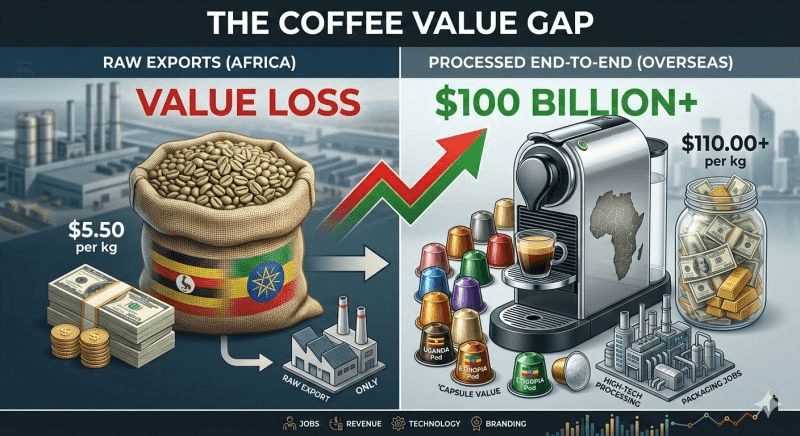
For decades, African coffee has meant extraordinary harvests and lopsided profit. As we move into 2026, the data still frames a stark reality: Africa captures less than 15% of the value of its own beans in many widely cited supply-chain analyses. Policymakers should treat that gap as structural, not accidental.
Focus on the top two exporters by relevance: Uganda and Ethiopia. In the 2024/25 season, Uganda surged as Africa’s top exporter by volume, while Ethiopia remains the anchor for Arabica value. Together they shipped on the order of nearly one million tonnes of green coffee and earned a combined $5 billion+ at the farm-gate and export stage - a real record, but only the first rung on the value ladder.
The coffee math on 1kg
When a kilogram of raw beans leaves an African port, it might trade in the ballpark of $5.50/kg. By the time similar quality reaches consumers in London, Paris, or New York, economics change shape:
- Raw export: ~$5.50/kg at origin.
- Roasted and bagged: on the order of $30/kg - a ~5× step-up on the product, before marketing and shelf margin.
- Single-serve capsules (the “pod” effect): ~$110/kg of product weight - roughly a 20× lift versus raw export in this stylized comparison.
- Per-cup retail: once you allocate grams per cup and café prices, effective value per kg of beans consumed can exceed $500/kg - order-of-magnitude 90× versus the export price - because consumers pay for place, brand, and habit, not green coffee alone.
These multiples are illustrative; spot prices, blends, and channels move daily. The point is directional: most of the wallet stays where roasting, packaging, and brand live.
The “5% opportunity”
If Ethiopia and Uganda processed only 5% of current crop into capsule-grade product at home - with acceptable quality and routes to market - the revenue from that slice alone can be modeled to rival or exceed a large share of today’s national green-coffee export receipts, before counting jobs and taxes downstream. The exact outcome depends on yields, conversion ratios, and price - but the order of magnitude is why the idea keeps resurfacing in policy circles.
By exporting raw beans, Africa is not only moving commodity; it is effectively exporting:
- Packaging and precision manufacturing (e.g. aluminum systems, filling lines, QA).
- Brand equity and origin storytelling that global roasters and retailers monetize.
- Industrial multipliers: chemical and process engineering, logistics, cold chain, and digital traceability.
The shift is starting
Uganda has signaled major investment intent toward soluble and roasted exports; Ethiopia has been cutting friction for roasted-at-origin brands. The strategic line is consistent: less “plantation for the world,” more “factory and brand for the world” - where the economics justify it.
What is the biggest barrier to scaling capsule-style processing in Africa? Is it capital for packaging lines (often $100M+ class when done at serious scale), or the gatekeeping power of retailers and global brand platforms in key markets?
That is the debate we want with policymakers, growers’ associations, processors, and investors.