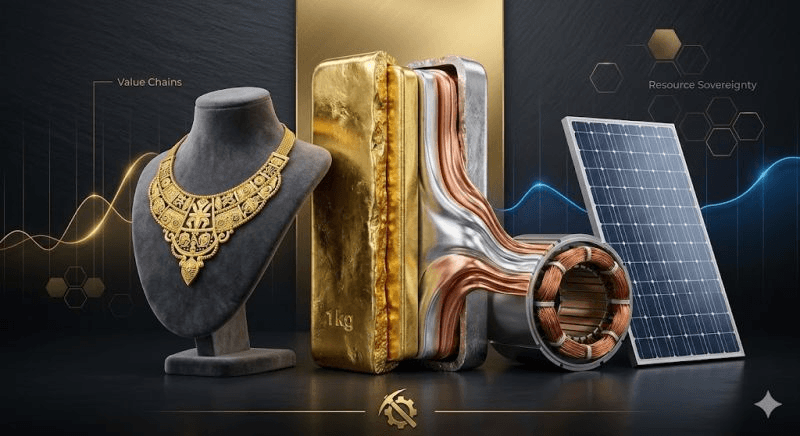
In the global gold trade, the “100-tonne club” marks the peak of mineral wealth. Ghana, South Africa, Mali, and Burkina Faso anchor world supply - alongside the rising potential of markets such as Ethiopia and Sudan.
As strategists, we look past the headline metal to what we call the industrial leak. When we export raw gold (doré), we pay an un-invoiced tax on our industrial future. Doré is never pure: we are effectively donating the catalyst metals the green-energy transition needs - without capturing their value at home.
The anatomy of a 1kg leak
- Gold (the headline): ~850g - What we currently price and export. At 100-tonne scale, that is on the order of 85 tonnes of gold-equivalent narrative - but the story does not end there.
- Silver (the tech catalyst): ~100g - Treated as “impurity.” At club scale, that is roughly 10 tonnes annually of silver sent away with the stream - enough, directionally, to matter for high-conductivity contacts in solar and electronics at serious scale.
- Copper (the infrastructure): ~50g - Treated as “waste.” Another ~5 tonnes annually in the same thought experiment - copper that could anchor wiring and motor windings in e-mobility and grid build-out.
The Veblen multiplier: from extraction to high-end manufacturing
What changes when we move from exporting doré to capturing fabrication and brand?
- The raw deal: Exporting 1kg of raw doré might earn on the order of $141,000 (illustrative; market-dependent).
- Refine and alloy: Take that kilogram toward 99.99% gold, recover silver and copper responsibly, and alloy into 21K heritage gold - here roughly 1,142g of alloy for manufacture.
- The manufacture: Hand-craft into 28 luxury necklaces at 40g each.
- Retail value: At an illustrative $7,000 per piece, the same starting kilogram implies about $196,000 at retail.
The strategy gain (illustrative): on the order of +$55,000 per kilogram in this stylized example - before counting the full system value of recovered “impurities” and domestic jobs. Extended across 100-tonne-club production, the GDP and balance-of-payments upside is measured in the billions if value chains are built - not if every tonne leaves as raw bar and invisible co-product.
The sovereign shield
Domestic refining is not only margin - it is currency and resilience. When central banks acquire refined 99.9% gold in local currency, they strengthen a hard floor for confidence and reserves. The goal is to move from being pure price takers on London benchmarks to using gold to back domestic industrialization - digital infrastructure, green manufacturing, and sovereign brand equity - instead of trading mineral optionality for paper alone.
The bottom line
Smuggling and raw export are symptoms of a missing value chain. Refineries plus luxury and industrial downstream mean gold - and its co-metals - flow to higher-paying domestic work instead of leaking as unpaid co-product.
Africa does not need to “find” wealth. We need to stop giving it away in the form of unpriced impurities and unstructured export.
How do we accelerate the shift from exporters of raw material to refiners of technology and brand? That is the conversation we want with policymakers, miners, refiners, and investors.